Family · Titles · Made · Easy
If it's not Uncle...
then what do I call him?
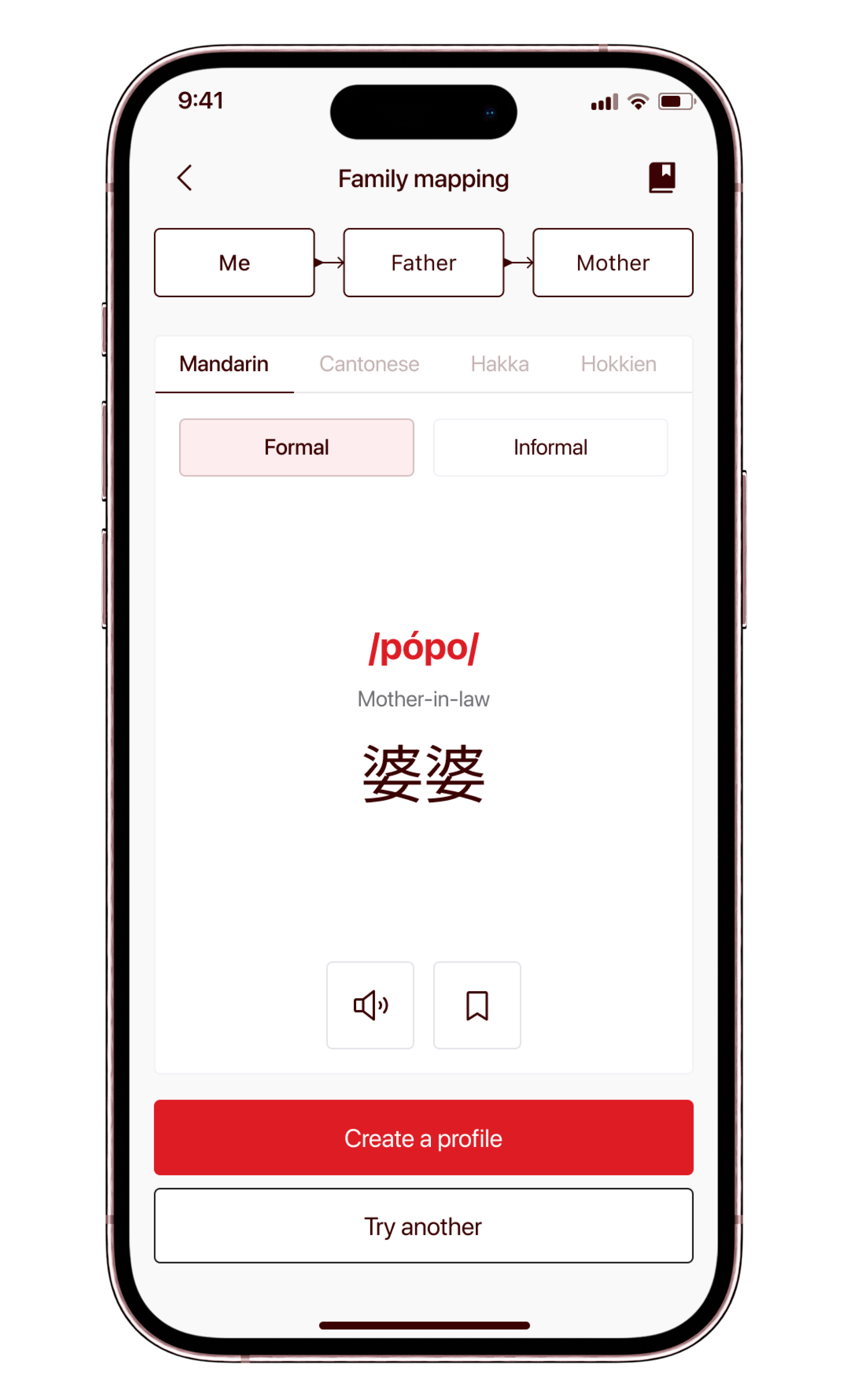
CallMyKin helps you navigate how to address family and relatives in various Chinese dialects — with native audio, a family tree builder, and quizzes that help you learn!
Free · No account needed · iOS & Android
The Struggle is Real
That moment of panic when a relative walks toward you and you have absolutely no idea what to call them.
CNY Reunion Chaos
15 relatives. Zero idea what to call them. You've been nodding and smiling for 3 hours straight.
The Auntie Incident
Called your husband's grandmother "Auntie." She hasn't forgiven you. That was four years ago.
Teochew Terror
Your in-laws speak Teochew. You speak… panic. Fluent, eloquent, very convincing panic.
Sound familiar? CallMyKin has you covered — across all 5 dialects.
See How It Works →Watch the Chaos Unfold
Relatable situations, zero judgment. More videos dropping soon!
The In-Law Test
The kwailou challenge
The Whatsapp Group
Never depend on chats for fast answers
The Classic Uncle Fail
No, not Uncle!
Dialect Bootcamp
Five dialects, one deadline, zero chill.
Hong Pao Hostage
No blessings, no red envelope.
The Hongbao Gauntlet
Survive the red envelope interrogation.
Hear It in Your Dialect
One relative. Five completely different titles. This is exactly why we built CallMyKin.
The official language of China, Taiwan, and Singapore with over 920 million speakers. Mandarin family terms are often the first ones diaspora Chinese encounter — but they're just one of many systems used across communities worldwide.
Spoken by around 85 million people, Cantonese dominates Hong Kong, Guangdong province, and large overseas communities in North America and Australia. Its rich tonal system and distinct vocabulary make family terms sound very different from Mandarin.
Taiwan Hokkien (Minnan / Taiwanese) is spoken by most of Taiwan's population and widely across Southeast Asia — especially Malaysia, Indonesia, and the Philippines. Many overseas Chinese families speak Hokkien at home, even when they don't realise it has a name.
Hakka people are famously described as the "wanderers" of China — scattered from Malaysia to Jamaica. With 40–50 million speakers worldwide, Hakka has its own distinct kinship system that surprises even native Chinese speakers from other dialect groups.
Teochew (Chaozhou) speakers have a strong presence in Thailand, Cambodia, Vietnam, and Malaysia. Despite linguistic similarities to Hokkien, Teochew has its own distinct vocabulary and pronunciation — enough to confuse even fluent Hokkien speakers.
Everything You Need to Get It Right
Native Audio
Hear every family term pronounced by real native speakers — in both formal and informal registers, across all 5 dialects.
Family Tree Builder
Map your actual relatives. Get the precise term for your specific family situation — not just a generic textbook list.
Smart Quizzes
Spaced repetition that actually works. You'll remember dà bó from èr bó — and still know it at the next reunion.
Daily Streaks
Build the habit. Keep the streak. Impress the in-laws at the next gathering. Never panic-smile again.
They Survived. So Can You.
I married into a Hakka family and had no idea what to call anyone. Three months with CallMyKin and I addressed my mother-in-law's sister correctly at CNY. She cried. Good tears.
I'm third-generation overseas Chinese. My grandparents speak Teochew but I never learned. This app helped me reconnect with them before it was too late. I'm not crying, you're crying.
My Cantonese husband was shocked when I correctly called his ji6 baak3 mou5 at a family dinner. I've never seen him look at me like that. Genuinely, thank you CallMyKin.
Ready to Call Your Kin
with Confidence?
Free Download. Works on iOS and Android.
🎉 Join thousands of families who finally know what to call each other